Here's How To Find Your Brand Voice With 5 Exercises

"Make it sound more us." Every brand has heard this note, and every writer has struggled to act on it, because "us" was never defined as anything more specific than a feeling in someone's head.
Most brand voice documents make the same mistake: three adjectives on a slide, "friendly, bold, trustworthy," with no way to tell if a sentence actually matches them or not.
A voice defined by adjectives alone can't be tested. Two writers reading "bold" will produce two different sentences, both technically bold, both sounding nothing alike. The fix isn't better adjectives.
It's replacing subjective description with measurable parameters, dimensions a writer can slide a sentence along and check against a reference point instead of a vibe.
These five exercises build that reference point from scratch.
Borrowed from a framework originally used to standardize enterprise content teams, this exercise forces voice into measurable axes instead of loose descriptors.Pick four spectrums relevant to your brand. A common starting set:
Formal ←→ Casual
Serious ←→
PlayfulMatter-of-fact ←→ Enthusiastic
Respectful ←→ Irreverent
For each one, mark where your brand sits, not at an extreme, but at a specific point. A brand that's "casual but not irreverent" and "enthusiastic but not over-the-top" has already said more than "friendly and bold" ever could, because a writer now has a position to check a sentence against instead of a mood to guess at.
Do this exercise with three people on the team independently, then compare. Disagreement here is useful.
It surfaces the gap between how leadership thinks the brand sounds and how the writers actually producing content interpret it.
Three adjectives alone leave too much room for interpretation. Pair each one with what it explicitly isn't.
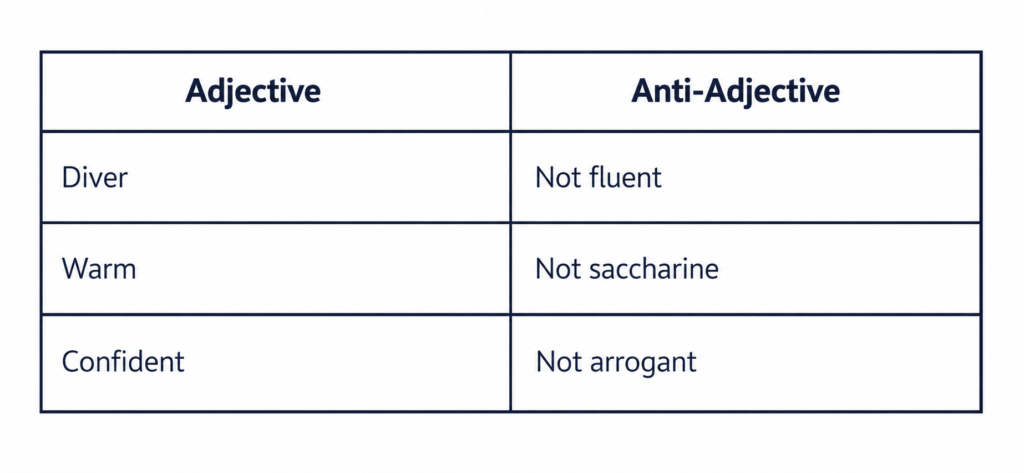
The anti-adjective does the real work. "Direct" alone could justify a curt, dismissive sentence. "Direct, not blunt" rules that sentence out immediately, because it names the failure mode the adjective alone couldn't prevent.
Every brand voice slide that lists adjectives without their opposites is leaving half the definition unwritten.
Voice is easier to define by contrast than in isolation. Pick three reference points, brands, public figures, even fictional characters, that sit near your voice but miss it in a specific, nameable way.
For example:
"We sound like [Brand A], but less corporate. We sound like [Brand B], but more precise. We're funnier than [Brand C], but never at the reader's expense."
Each comparison isolates one dimension your own team might not think to articulate on its own, because it's easier to notice what's missing next to something familiar than to describe your own voice from scratch.
This exercise also catches drift early. If a new piece of copy reads closer to Brand A than to your own defined position, that's a concrete, checkable deviation, not a subjective "this doesn't feel right" note that's hard to act on.
Build two lists side by side: words and phrasing patterns your brand actually uses, and ones it deliberately avoids.
Use:
Contractions ("we'll," "you're")
Second person, direct address
Short, declarative sentences for key claims
Avoid:
Corporate filler ("synergy," "leverage," "best-in-class")
Passive voice for anything the brand is responsible for
Exclamation points outside of genuine celebration moments
This exercise turns voice into something a writer can check line by line, not just page by page.
A single sentence with three items from the "avoid" list is an objective flag, not a matter of taste, which makes editing faster and takes the disagreement out of revision rounds.
Take one plain, voiceless sentence and rewrite it across three different contexts: a sales page, an error message, and an apology email. The same underlying voice should be recognizable in all three, even though the situations call for different levels of energy.
Neutral version: "Your payment did not process. Please try again."
In-voice sales-page energy: "That didn't go through, let's get you sorted so you don't lose your spot."
In-voice error message: "Payment didn't go through. No charge was made. Try again, or use a different card.
"In-voice apology: "That's on us, not your card. We're looking into it now and we'll email you the second it's fixed."
If all three still sound like the same brand despite the different emotional register, the voice is well-defined.
If they sound like three unrelated writers, the earlier exercises need another pass before this one will hold up.
The output of all five exercises fits on a single page: the four spectrum positions, the adjective and anti-adjective pairs, the three comparison points, the word bank, and one worked example of the rewrite test.
That page replaces the subjective brief. A new writer, or an AI system generating first drafts, has a checkable reference instead of a mood board, and every piece of copy going forward can be tested against a specific standard instead of someone's gut reaction to whether it "sounds right."
The adjectives were never the problem. The absence of anything to check them against was.Want your brand voice documented into a usable one-pager?
Get in touch and we'll run your team through all five exercises.